
Thermistor vs Thermostat: Which One Does Your Appliance Need?
A thermistor measures temperature; a thermostat acts on it. An NTC thermistor is a resistor whose value falls as it warms, so a controller can read the exact temperature. A bimetal thermostat is a switch that opens or closes its own contacts at one fixed point and carries the load current itself.
- Thermistor: a continuous reading, no switching, needs a controller to act on it.
- Thermostat: one trip point, switches up to 16 A at 250 V AC directly, needs no electronics.
- Both: many appliances fit the pair, with the thermistor running the process and the thermostat standing guard.
We build both parts for appliance makers, so this guide is written from the design bench, not the service van. It covers how each one works, where each fits, why so many products use the two together, and what to check before you swap one for the other.
What is the difference between a thermistor and a thermostat?
The difference is what comes out. A thermistor gives a number, a resistance that maps to one temperature. A thermostat gives a decision, contacts open or closed. The first needs a microcontroller, a reference voltage and a lookup table before anything happens. The second needs nothing; heat moves the disc and the disc moves the contacts.
That one distinction drives almost every other trade-off: cost, accuracy, safety approval, and what happens when something fails.
How does a bimetal thermostat work?
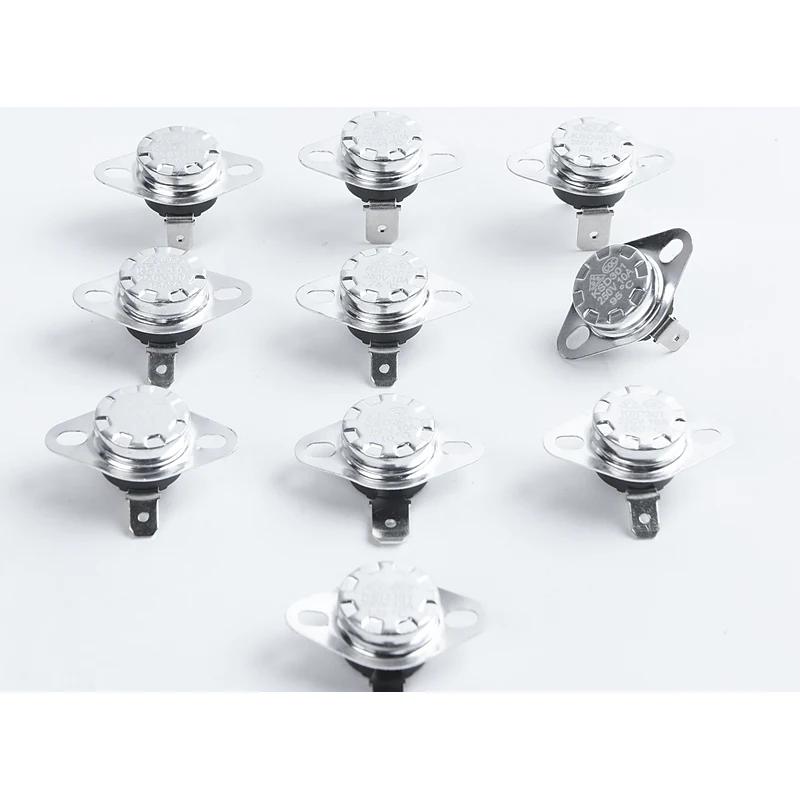
Inside the cap sits a dished disc made of two metals bonded together. They expand at different rates, so as the disc heats it builds stress until, at the calibrated temperature, it snaps through to the opposite curve. A pin transfers that movement to the contacts, which open in a few milliseconds. As the part cools by its reset differential, the disc snaps back and the contacts close again. For the full mechanism, see how a snap-action disc flips at its set point.
Typical figures for our KSD301 family: 250 V AC at 10 A or 16 A, a set point anywhere from 0 °C to 180 °C in a bakelite housing (45 °C to 260 °C in ceramic), ±5 K tolerance as standard and ±3 K on request, and 30,000 to 100,000 switching cycles depending on the build.
How does an NTC thermistor work?
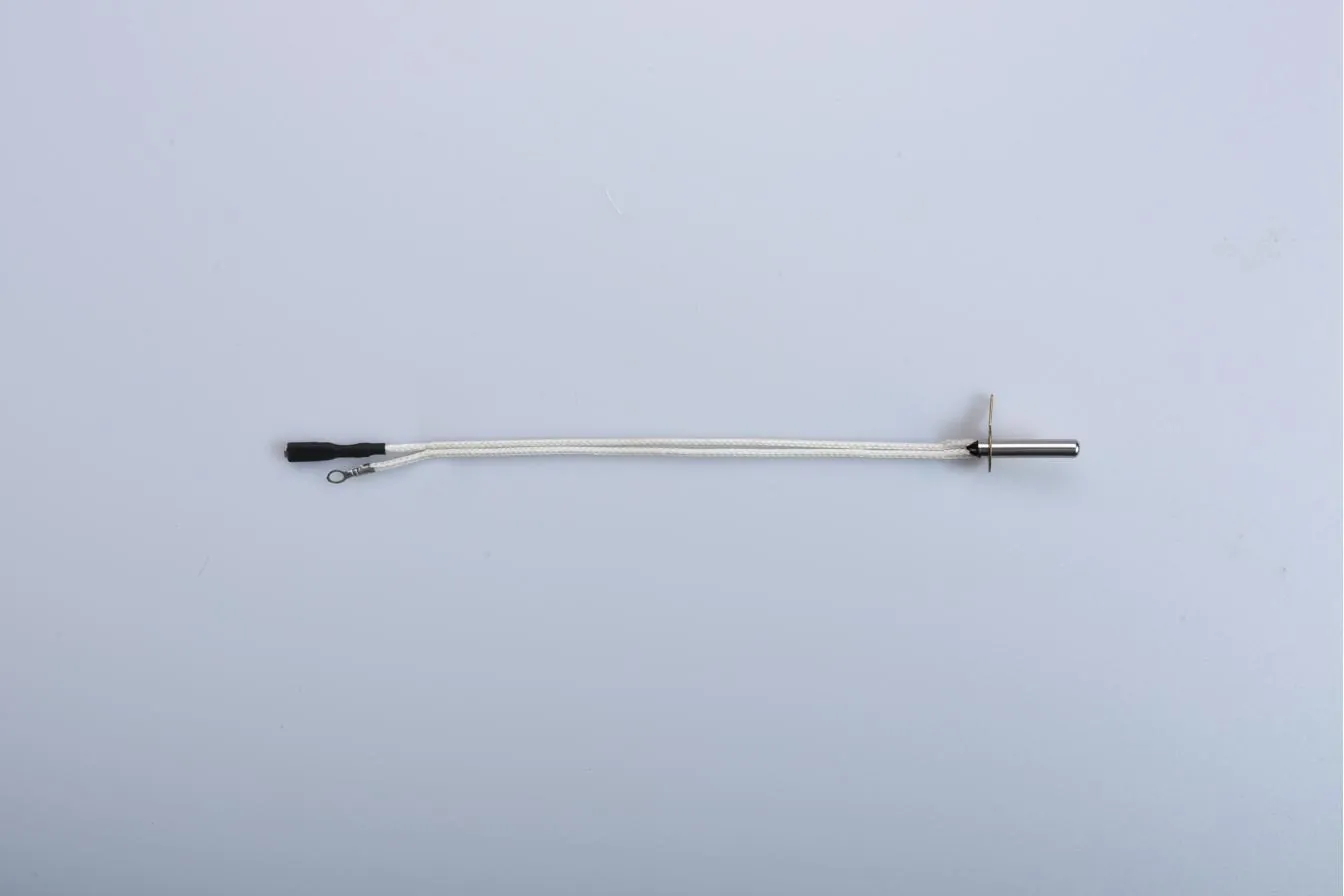
An NTC (negative temperature coefficient) thermistor is a small ceramic semiconductor bead whose resistance drops as temperature rises. Two numbers describe it: R25, the resistance at 25 °C, and the B value, which sets how steeply the curve falls. The controller reads the resistance through a voltage divider and converts it to temperature.
Here is how one common part, a 10 kΩ thermistor with B = 3,380 K, behaves across an appliance range:
| Temperature | Resistance |
|---|---|
| −30 °C | 111.3 kΩ |
| 0 °C | 27.28 kΩ |
| 25 °C | 10.00 kΩ |
| 50 °C | 4.161 kΩ |
| 75 °C | 1.925 kΩ |
| 100 °C | 0.974 kΩ |
Read the table for its shape, not just its values. Between 0 °C and 25 °C the resistance falls by more than 17 kΩ. Between 75 °C and 100 °C it falls by under 1 kΩ. So the same part that resolves a fridge compartment to a fraction of a degree gives the controller far less signal near boiling, which is why a kettle or boiler sensor is often specified with a different R25 or B value. Our custom NTC thermistor probes run from 5 kΩ to 200 kΩ at 25 °C, with B values from 3,380 K to 4,200 K held to ±1%.
Thermistor vs thermostat: how do they compare?
| Bimetal thermostat | NTC thermistor | |
|---|---|---|
| Output | Contacts open or closed | Resistance that tracks temperature |
| Switches the load? | Yes, up to 16 A at 250 V AC | No, the controller switches through a relay or triac |
| Set point | Fixed at the factory | Set in firmware, can change |
| Accuracy | ±5 K standard, ±3 K available | Better than ±1 K with a ±1% part and a good table |
| Gap between on and off | Built into the disc | Chosen in software |
| Needs electronics? | No | Yes |
| Typical job | Over-temperature cut-out, simple on/off control | Closed-loop control, displays, staged heating |
When should an appliance use a thermostat?
Use a thermostat when one temperature is all the product needs to know. A kettle that must switch off at the boil, a heater that must never pass 85 °C, a motor winding that must stop before its insulation cooks: each is a single decision, and a disc makes it without a board, a power supply or a line of code.
It is also the natural choice for protection. Under IEC 60335-1, the household appliance safety standard, a protective function that relies on an electronic circuit must keep working through specified component faults, and any software behind it is assessed under Annex R. A bimetal cut-out sits outside that chain. On a small motor, a thermal protector clipped to the winding does the same job, opening the circuit itself when the coil overheats.
When is a thermistor the better choice?
Use a thermistor when the product has a controller and needs to know more than "too hot or not". Coffee machines that hold brew water within a degree or two, induction hobs that step power down as the pan heats, inverter fridges that vary compressor speed, and heat pumps that decide when to defrost all depend on a live reading.
Watch one detail that catches new designs: self-heating. The measuring current warms the thermistor itself. A 10 kΩ part in a 3.3 V divider with a 10 kΩ resistor dissipates about 0.27 mW at 25 °C. With a dissipation constant of 2 mW/K in still air, that adds roughly 0.14 K of error. That is fine for a water heater, but worth checking on a precision part. A higher R25 or a lower drive voltage reduces it.
Why do many appliances use both?
Because control and protection are different jobs, and the two parts fail differently. An electronic water heater, for example, regulates with an NTC probe on the controller and keeps a manual-reset bimetal cut-out on the tank as an independent high limit. If a relay welds shut or the firmware hangs, the thermistor can only report the rising temperature; the cut-out opens the circuit regardless. Our guide to water heater thermostats and high-limit cut-outs walks through that pairing.
The same split appears elsewhere:
- Refrigerators: NTC probes read each compartment and the evaporator, while a bimetal defrost thermostat ends the defrost heater cycle.
- Heat pumps and air conditioners: outdoor coil sensors come in both forms. Some defrost boards read a snap-action disc, others a 10 kΩ thermistor.
- Motors and pumps: inverter drives read an NTC to derate before trouble, and a bimetal protector on the winding still opens the supply if cooling fails. More on this in our motor thermal protection guide.
Can you replace a thermostat with a thermistor, or the reverse?
Not directly. A thermostat is a switch in the load path, and a thermistor cannot carry that current. Fit one in its place and the circuit sees a few kilohms where it expected a closed contact. Going the other way, a controller that reads resistance will see either zero ohms or an open circuit from a thermostat and flag a sensor fault. Some universal control boards accept either type through a selector, but that choice belongs to the board, not the part. When you change sensor type, you change the circuit design.
How do you test a thermistor and a thermostat?
For a thermostat, check continuity at room temperature against the drawing (closed for a normally closed part, open for a normally open close-on-cooling disc), then heat it slowly in an oil or air bath and note where the contacts change state. For a thermistor, measure resistance at a known temperature and compare it with the R/T table, allowing for the stated tolerance. A reading of zero or infinite ohms means the element or a lead is damaged.
Frequently asked questions
Q: Is a thermistor a type of thermostat? A: No. A thermistor is a temperature sensor; it only changes resistance. A thermostat is a switch that acts at a set temperature. A thermostat can be built around a thermistor and a controller, but the thermistor alone switches nothing.
Q: What happens when a thermistor goes bad? A: It usually fails open or drifts. An open thermistor reads as an impossible temperature, so a well-designed controller shuts down and shows a sensor fault. A drifted one reads wrong but plausible values, which is harder to spot and is why tolerance and lead sealing matter at the specification stage.
Q: What are the disadvantages of a thermistor? A: It needs a controller to do anything, its curve is non-linear so it needs a lookup table or equation, it self-heats slightly, and a standard NTC part works over a narrower range than an RTD or thermocouple. For appliance temperatures, from about −30 °C to 250 °C depending on the housing, those limits rarely bite.
Q: What is the difference between a thermistor and a thermometer? A: A thermometer is a complete instrument that shows a temperature. A thermistor is one component that a thermometer, or an appliance controller, can be built around.
Q: What is the difference between an NTC and a PTC thermistor? A: An NTC thermistor's resistance falls as temperature rises and is used for measurement. A PTC thermistor's resistance jumps sharply at one temperature and is used to trip a protection relay, for example in three-phase motor windings.
Where to go from here
- KSD301 snap-action disc thermostats - auto or manual reset, set point and termination made to order.
- NTC thermistor probes built to your R/T table - R25, B value, housing and lead to your drawing.
- What is a thermostat switch? - the full family of thermal switches, if you are starting further back.
If your design needs a sensor and a cut-out that agree with each other, send us both set points and the controller's R/T table through our engineering contact page.